
A Whisper of Vein Across a Pale Island Deck
Sparse mineral threads on a pale island only succeed when the pattern is scaled to the block and booked across any drop, or the island splits in two.
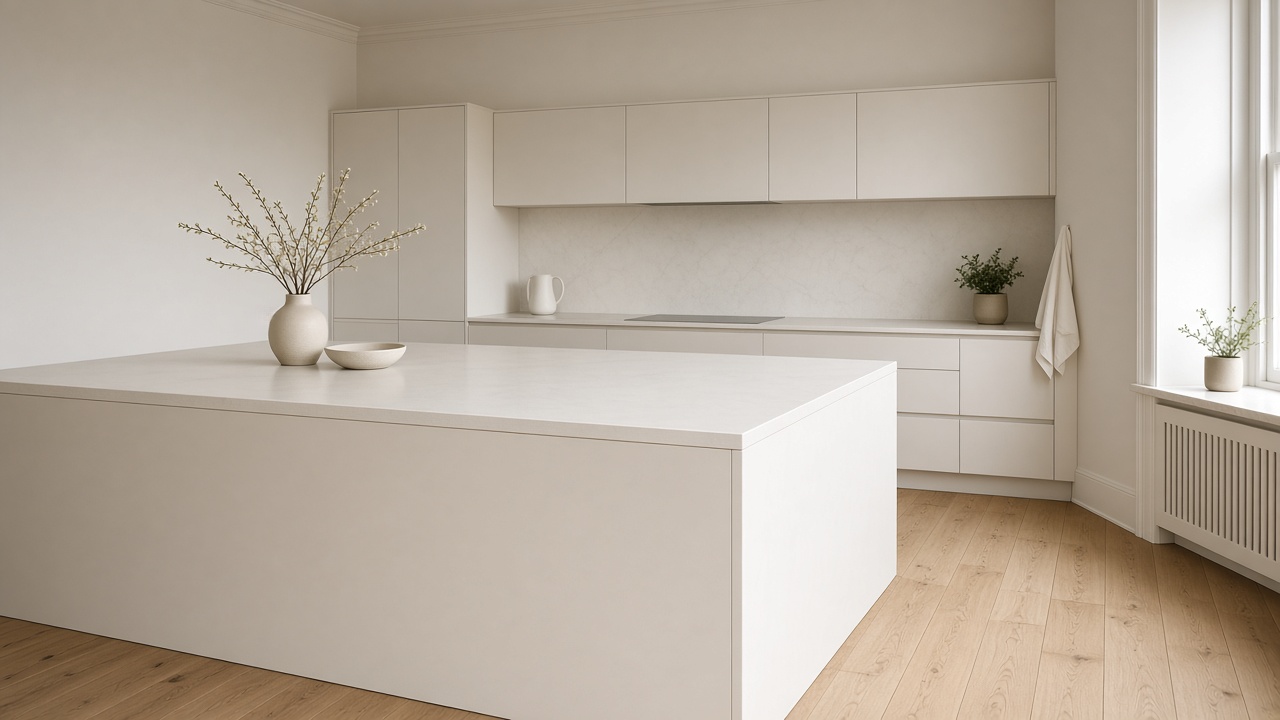
A pale island can carry a mineral thread without becoming a showpiece, but only if the pattern is a whisper you notice on the second look. Apollo Kitchen Worktops will not treat a sample chip as proof of scale, because one elegant line on a hundred-millimetre square can become a busy map on a long block. Quiet veining also needs a fabricator who books the sheet, or the faint line dies at a waterfall and the island looks like two products.
Ask for a full-sheet photograph before anyone talks length
If the pattern repeats every 400 millimetres it will look printed. Apollo prefers solids where the vein is irregular and sparse, so the eye can rest. In a small galley, skip veining on the perimeter and keep a faint movement only on the island. Two veined planes in a tight room cancel the calm you came for. Through-colour acrylic lets you sand a corner into one plane, which is the practical reason pale islands can carry a hint of marble without a slab puzzle.
Demand a sheet map, not a verbal promise that it should line up. Mark where the hob sits, where a seam is allowed, and which way the thread runs.
Draw any drop so the thread turns the corner as one mineral
If the island drops to the floor, the vein must turn the corner as if it were stone. That is a drawing, not a hope. Put unavoidable seams on a cabinet joint, never through the main thread. Keep waterfall thickness the same as the deck so the line does not jump. A faint vein that breaks at the arris looks accidental, which is worse than having no vein at all.
Stop a waterfall a few millimetres short of an uneven floor so it does not telegraph every flag. In a modest kitchen a square built-up nose is often enough; a full drop can turn a pale island into a plinth.
- Insist on a sheet map rather than a spoken assurance.
- Park seams on a cabinet joint, never through the principal thread.
- Keep waterfall thickness identical to the deck so the vein does not jump.
Park the hob in a quieter field of colour
A pale island with one whispered vein should not have an 800 millimetre hob punched through that vein. Shift the hob to a quieter field, or choose a plain pale for the cooking zone and keep the veined sheet for the seating overhang. Flush induction helps the plane stay architectural. Controls on the front edge beat a raised ridge that cuts the pattern in half.
Cable through the carcass. A surface grommet in a pale field is a dark speck you will notice every time you wipe. Sockets belong in an end panel or a set-back well, not on the seating rim.
Live with the thread in your own daylight before cutting
Veining that looks grey in a warehouse can look beige beside your floor. Apollo will not lock a veined pale until the board has sat in the room. If the thread shouts once it is next to oak, choose a quieter sheet. There is always a quieter sheet. After fitting, clean along the vein, not across it, for the first weeks so residual polish does not highlight the pattern. Then treat it as a worktop, not as a painting.
Keep a batch-matched offcut. Evening repairs to a heat ring are sanded through the colour, and a matching piece from the same run is worth more than a new chip card in two years.
Next step with Apollo Kitchen Worktops
Order a sample, then request a fitted quote or browse the worktop collection. The colour should be judged in your own daylight before anyone templates the run.