
Pale Solid Surface Above a Microcement or Polished Concrete Floor
A pale solid worktop over microcement or polished concrete works when the two greys are chosen as a pair, with enough contrast that the room does not blur into one mass.
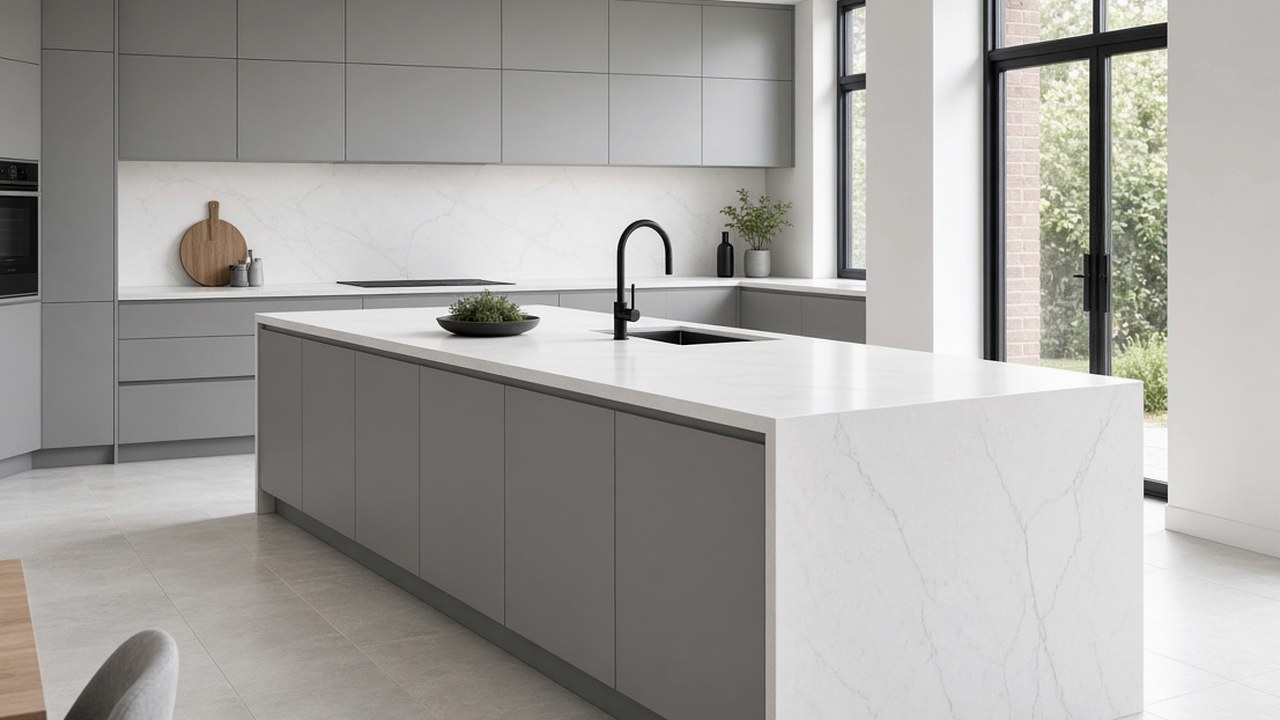
Microcement and polished concrete floors have become the default backdrop for a certain kind of quiet kitchen, and a pale solid worktop is often the next thing on the mood board. The pairing can be beautiful, but it can also turn into a single grey fog from doorway to garden. Apollo Kitchen Worktops treats the floor as the first colour decision rather than the last, and chooses the worktop to sit a clear half-step above it in lightness and warmth.
Decide which grey is the floor and which is the furniture
Seamless floors are rarely one flat colour. Microcement is trowelled by hand, so it carries clouds, burnish marks and a slightly mottled surface; polished concrete shows aggregate and faint cracking over time. A pale solid surface, by contrast, is even and calm. That difference is useful. Let the floor be the textured, slightly darker ground and let the worktop be the smooth, lighter plane. If you try to match them exactly, the island begins to look as if it has grown out of the floor, and in overcast British light the edge of the worktop disappears.
Take a sample board down to floor level as well as up to worktop height. Stand it on the floor next to a sample of the finished microcement, then lift it to 900mm and look again. Most people find that a worktop one or two steps paler than the floor, with a hint more warmth, reads as furniture rather than as a continuation of the screed.
- Keep the worktop visibly lighter than the floor, not a near-match.
- Judge the pair at floor level and at worktop height.
- Ask the floor contractor for a cured sample, because fresh microcement darkens as it dries.
Match undertone before you match lightness
Grey floors lean somewhere: blue-grey, green-grey, taupe or warm putty. A pale solid that leans the other way will look dirty beside it. Cool blue-grey microcement tends to suit a pale with a faint grey or mineral note; a warm putty floor usually wants a bone or soft ivory worktop. The quickest test is to lay a sheet of plain printer paper between the two samples. Whichever sample looks further from the white paper is carrying the stronger undertone, and that is the one you design around.
Polished concrete with a visible aggregate brings its own colour, often flecks of buff, rust or charcoal. Pick one of the lighter flecks and use it as the reference when you choose the worktop, rather than the overall impression of grey. This is the same discipline Apollo uses when judging a colour against cabinet paint, explained in ivory solids tested against white paint.
Control sheen so floor and worktop do not compete
A sealed microcement floor is usually matt or satin, while polished concrete can be close to gloss. The worktop should not fight the floor for reflections. With a satin floor, a honed or satin solid surface keeps the room calm and avoids a second shiny plane catching the rooflight. With a glossy polished floor, a matt worktop gives the eye somewhere to rest. Mixing two glossy horizontal planes in a small room can make the space feel restless, especially under a run of downlights.
If the kitchen is open to a garden, check the reflected sky too. A high-sheen floor throws cool light up onto the underside of the worktop overhang, which can make a pale edge look greyer than the top. A slightly thicker, square nose with a small arris usually handles that better than a razor-thin edge. For more on sheen choices, see honed pale planes for rooms that must stay soft.
Detail the plinth and the island base
Where a pale island meets a seamless floor, the plinth becomes a line in the composition. A recessed plinth in a darker tone creates a shadow gap that makes the island float, which suits a minimal scheme. A plinth finished in the same microcement as the floor can look very clean, but it needs careful coordination between trades so that the screed thickness, the plinth height and the worktop height all work with standard cabinets.
Talk to your fitter before the floor goes down about where cabinets sit, whether the floor runs under the units or stops at the plinth, and how the island will be fixed. Microcement is thin and can crack if carcasses are screwed through it carelessly. A solid surface worktop is templated after the cabinets are fixed, so any change in floor level at that stage alters the final worktop height.
- Agree whether the floor runs under the cabinets or stops at the plinth line.
- Protect a new microcement floor during templating and fitting with hardboard, not dust sheets alone.
- Keep the island plinth recessed so the pale top reads as a lid.
Think about daylight across a large open floor
Seamless floors are often laid in big open-plan extensions with glazing on two sides. That means the worktop is judged in changing light across the day. Morning light from the east tends to be crisp and slightly cool; late afternoon light from the west is warmer and lower, raking across the floor and the edge of the island. A pale solid that looks perfect at noon can look flat at breakfast if its undertone is too cool for the room.
Leave the chosen sample on the island position, on top of a cardboard box at the right height, for a few days. Look at it at breakfast, mid-afternoon and after the lights are on. If it holds its colour against the floor at all three times, you have a genuine pair rather than a lucky photograph. Apollo explains the at-home trial in more detail in trial boards before you commit a pale worktop run.
Keep the rest of the palette quiet
A pale worktop over a pale grey floor already gives you two large calm surfaces. Everything else should support them rather than add more greys. Warm timber stools, a single colour on the cabinet fronts, or a brushed metal tap can give the eye something to hold. Too many near-greys, such as a grey splashback, grey cabinets, grey worktop and grey floor, will make the room feel under-lit even on a bright day.
If you want contrast, put it in one place: a darker island base, a timber shelf, or a run of tall units in a deeper tone. Keep the worktop itself calm and let the floor provide the texture.
Questions about pale worktops on seamless floors
Can I use the same colour for the worktop and the microcement floor?
You can, but it rarely looks as intended. The textures are different, so the two surfaces tend to read as slightly mismatched rather than identical. Most calm schemes work better with the worktop a little lighter and smoother than the floor.
Will a pale solid surface show marks more than the floor?
Everyday marks on a pale satin or honed worktop are usually easy to wipe away, and solid surface can be lightly refinished if it scuffs. A seamless floor tends to show footprints and water marks more readily than a pale worktop does.
Should the floor go down before the worktop is templated?
Usually yes. The template should be taken once cabinets are fixed at their final height, which depends on the finished floor level. Agree the order of work with your builder and fitter before you book dates.
Is a heavy island a problem on microcement?
The weight is carried by the cabinets and the substrate below the microcement, not the thin decorative layer itself. The risk is mechanical damage during fitting, so protect the floor and ask the fitter how the island will be fixed.
Next step with Apollo Kitchen Worktops
Order a sample, then request a fitted quote or browse the worktop collection. The colour should be judged in your own daylight before anyone templates the run.